
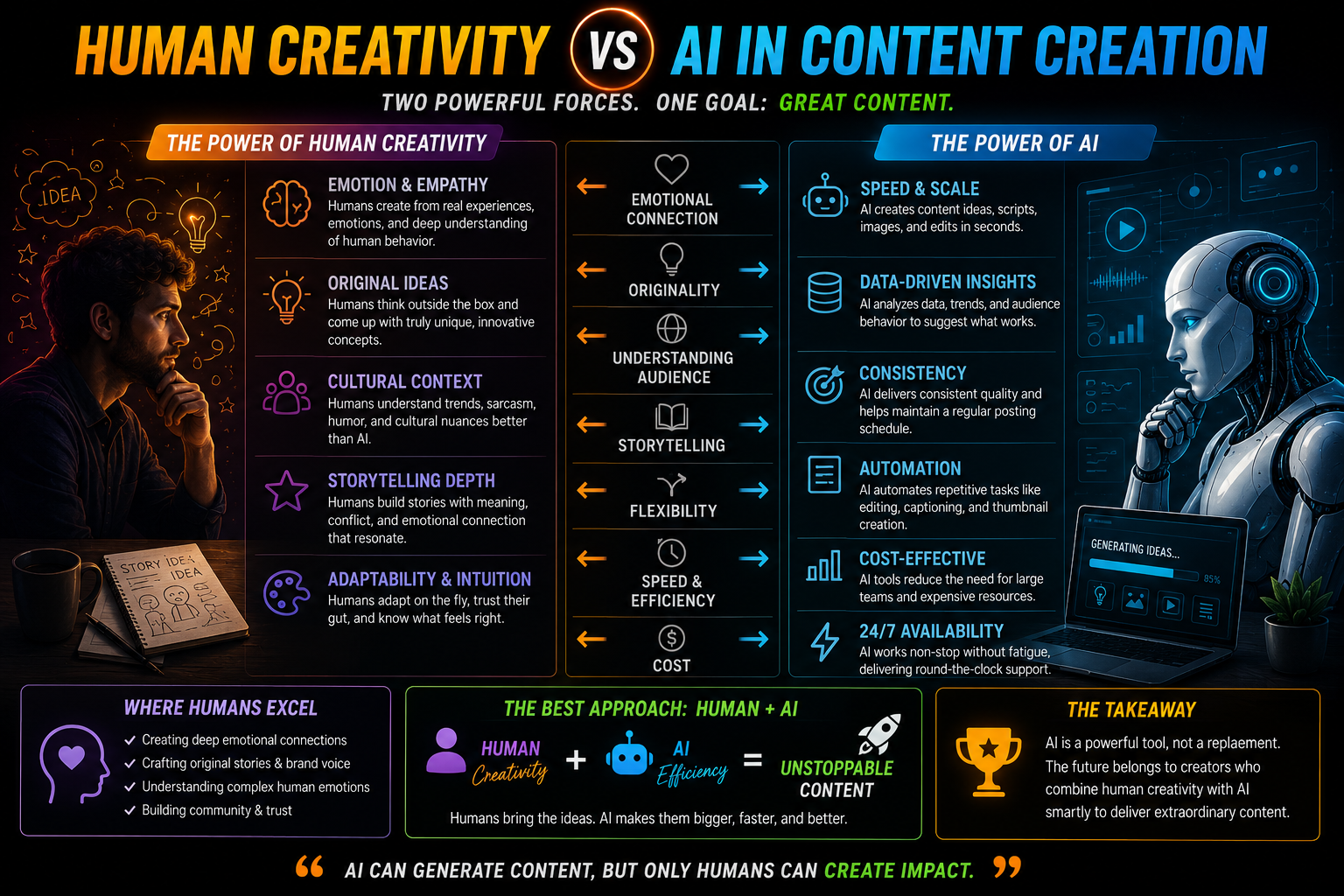
Introduction to Human Creativity and AI
- Human creativity is a multifaceted phenomenon characterized by the ability to generate original ideas, innovate, and express individual thoughts and emotions through various forms of art and communication. This capacity has been a defining feature of humanity, fostering cultural, scientific, and technological advancements throughout history. From the inception of cave paintings to the development of digital art and multimedia, human creativity continues to evolve, reflecting the complexities of societal changes and personal experiences.
- The flourishing of artistic endeavors has led to a deep appreciation for creative processes, which often require emotional and cognitive engagement. This allows individuals to not only create but also convey meaning and connect with audiences on an emotional level. In contrast, artificial intelligence (AI) has emerged as a powerful instrument that complements human creativity by harnessing vast amounts of data, identifying patterns, and producing content across various mediums.
- AI's integration into content creation has opened new avenues for collaboration and innovation. As a tool, it can facilitate the generation of ideas, enhance productivity, and streamline processes for content creators. While human-generated content often incorporates nuances of emotion, context, and subtleties of tone, AI-generated content is grounded in algorithms that analyze historical data and trends. Consequently, AI can assist creators in producing videos, blogs, and other formats that resonate with specific target audiences, making platforms like YouTube increasingly sophisticated in managing content curation.
- Understanding the interplay between human creativity and AI is vital for optimizing content creation strategies. As we delve deeper into their relationship, we will explore how this synergy can redefine traditional notions of creativity and efficiency in the digital age.
Understanding Human Creativity
- Human creativity is an intrinsic quality that manifests through imagination, innovation, and the ability to think beyond traditional boundaries. It is deeply rooted in our consciousness, influenced by a myriad of factors including personal experiences, cultural backgrounds, and emotional states. The origins of creativity can be traced back to both biological and psychological components, suggesting that it is not merely an artistic endeavor, but a fundamental aspect of human existence that aids in problem-solving, communication, and the development of new ideas.
- The psychological perspective on creativity emphasizes the interplay between cognitive processes and emotional influences. Neurobiological studies suggest that creative thought often emerges from a dynamic brain environment, wherein regions responsible for memory, emotion, and analytical thinking collaborate. This unique synergy enables individuals to make connections between disparate concepts, fostering the innovative leaps that characterize human creativity. Emotions also play a pivotal role, as they often serve as the impetus for creative expression—be it the joy derived from creating music or the melancholy inspiring poignant poetry.
- Moreover, human creativity serves significant functions across various fields, including art and literature, where it allows for the exploration of diverse perspectives and the conveying of complex ideas. In disciplines such as science and business, creative thinking is indispensable for identifying novel solutions to challenges and driving growth. This multifaceted utility highlights the irreplaceable nature of human creativity, as it encompasses not only the intellectual capability to produce original work but also the emotional depth that enriches our cultural and societal landscapes.
The Rise of AI in Content Creation
- Over the past few years, artificial intelligence (AI) has made significant strides in the realm of content creation, redefining how industries approach the generation and management of written material. Among the most pivotal advancements are improvements in natural language processing (NLP), machine learning, and neural networks. These technologies enable machines to not only comprehend but also generate human-like text, facilitating a broad array of applications in content-related fields.
- Natural language processing, a subfield of AI, focuses on the interaction between computers and human language. Tools leveraging NLP can analyze and generate text efficiently, offering solutions for various industries seeking innovative content delivery methods. For instance, marketing teams can utilize AI to create tailored email campaigns and social media posts, allowing for targeted messaging that resonates with specific audiences.
- Machine learning algorithms further enhance AI’s capacity to produce high-quality content. By processing large datasets, these algorithms refine their ability to generate coherent, engaging narratives. AI content generation tools like OpenAI's ChatGPT serve as prime examples, as they generate diverse written content that caters to specific directives, spanning from creative writing to technical documentation.
- Another vital component in this evolution is the development of neural networks, which facilitate deeper learning processes mimicking how the human brain works. By employing these networks, AI can recognize patterns in data, leading to richer content creation that incorporates context and emotional undertones. Industries such as journalism are leveraging these advancements to automate routine reporting tasks, allowing journalists to focus on investigative and in-depth stories while ensuring that essential updates are still available.
- With these tools, AI is revolutionizing content creation, presenting opportunities for efficiency and customization. As these technologies continue to evolve, understanding their implications on the content landscape becomes increasingly essential.
Comparing Outcomes: Human vs AI-generated Content
- The evolution of artificial intelligence (AI) has prompted discussions about its capabilities in replicating human creativity, especially in content creation. One key area of comparison is the quality of content produced by humans versus that generated by AI programs. Various factors such as originality, emotional depth, engagement, and cultural understanding play important roles in assessing these outputs.
- Originality remains a significant differentiator between human and AI-generated content. While AI can generate text based on existing data, often producing pieces that feel formulaic or derivative, human writers draw on personal experiences and unique insights that infuse their work with originality. For instance, a human-created blog post on travel might weave in tales of personal adventures, capturing subtle nuances that AI may overlook.
- Emotional depth and nuance are areas where human creators typically excel. People can instinctively tap into complex emotions and effectively convey them through their writing. An article about mental health written by a human may involve vulnerability and empathy, enabling a deeper connection with readers. In contrast, AI-generated pieces may lack this emotional resonance, often appearing analytical and less relatable.
- Engagement is another criterion crucial for content effectiveness. Content created by humans often prompts interaction, as it resonates on a personal level with audiences. For example, narratives incorporating storytelling techniques can captivate readers, striking a chord that encourages them to share and discuss. While AI can craft content designed for engagement, it may not consistently understand the subtleties of audience dynamics.
- Understanding cultural context is imperative in content creation. Human writers are equipped to navigate complex social settings and cultural references, which enhances the relevance and acceptability of their work. AI, restricted to the data it is trained on, may misinterpret or misrepresent cultural elements, leading to content that could be deemed inappropriate or irrelevant. Thus, while AI is advancing rapidly, the qualitative differences between human and AI-generated content highlight the irreplaceable value of human creativity in areas requiring emotional and cultural insights.
The Collaboration between Human Creatives and AI
- The intersection of human creativity and artificial intelligence (AI) has opened up new avenues for content creation, particularly in the realm of digital media. In recent years, platforms like YouTube have become integral in showcasing how these two forces can work in tandem to produce high-quality, engaging content. With AI tools at their disposal, creators can enhance their workflows, streamline repetitive tasks, and ultimately focus more on the creative aspects of their projects.
- One of the significant benefits of using AI in content creation is the ability to generate ideas and concepts that may not have been previously considered by human creators. For instance, AI algorithms can analyze vast amounts of data, recognizing patterns and trends in viewer engagement on platforms such as YouTube. These insights can inform content strategy, ensuring that creators remain relevant and responsive to their audiences' preferences. As a result, human creators can leverage these technologically driven suggestions to craft videos that not only captivate viewers but also retain their unique voice.
- Furthermore, AI technologies can assist in automating various elements of the editing process, allowing human creators to spend less time on technical aspects while still achieving professional-quality results. For instance, AI-powered editing software can help with video stabilization, color correction, and even sound mixing, enhancing the overall quality of the work. This collaboration empowers creators to invest more time in ideation and storytelling, pushing the boundaries of their creativity.
- In conclusion, the partnership between human creatives and AI systems represents a fertile ground for innovation in the content creation landscape. By harnessing the strengths of AI tools while maintaining their distinctive styles, human creators can achieve greater efficiency and bring forth new, inventive content that resonates with audiences across platforms such as YouTube.
The Limitations of AI in Content Creation
- As artificial intelligence (AI) continues to evolve, its application in content creation has become increasingly common. However, despite the impressive capabilities of AI, there remain significant limitations that hinder its ability to fully replicate human creativity. One of the primary drawbacks is the absence of genuine emotional connection. AI-generated content often lacks the nuanced understanding of human emotions and experiences that is intrinsic to human creators. As a result, the content produced may seem mechanical or superficial, failing to resonate deeply with audiences.
- Furthermore, AI faces inherent creativity constraints that prevent it from producing original ideas or innovative concepts. While algorithms can analyze vast amounts of data to generate content based on existing patterns, they are inherently limited to the information they have been trained on. This means that AI struggles to think outside the box or generate entirely novel concepts, which is a hallmark of human ingenuity. Content creation, particularly in genres such as storytelling, art, and music, often requires an innovative spark that AI lacks.
- Moreover, AI's inability to convey complex human experiences is a significant barrier to its effectiveness in content creation. Human life is filled with varied experiences that shape perceptions, beliefs, and artistic expression. AI can mimic language and style but cannot authentically capture the depth of these shared experiences. Whether through visuals on platforms like YouTube or written articles, human creators incorporate personal insights that enable them to touch on themes of empathy, love, sadness, and joy. As long as these limitations exist, the value of human creativity in content remains irreplaceable.
Ethical Considerations in AI Content Creation
- The rapid advancement of artificial intelligence (AI) technologies has brought about significant changes in the field of content creation, especially regarding platforms like YouTube. While AI has the capability to generate content swiftly and efficiently, it raises several ethical concerns that need to be addressed. One of the primary issues is copyright. When an AI system creates content based on existing works, it often utilizes data that may belong to other creators, potentially infringing on their intellectual property rights. This situation creates a complex landscape where determining ownership and accountability can become contentious.
- Another critical issue is plagiarism. AI-generated content can inadvertently replicate existing ideas, phrases, or even entire pieces without proper attribution. The fine line between inspiration and theft is often blurred, particularly when the algorithms trained on vast datasets might generate outputs similar to pre-existing works. It is essential for creators utilizing AI to maintain a high standard of originality and ensure transparency in their processes.
- Moreover, the potential for misinformation is a pressing concern in the era of AI content creation. Machine-generated content may lack the factual accuracy or context that a human creator would typically provide. This phenomenon raises the risk that audiences could be misled by content that circulates widely, such as videos on YouTube, hence amplifying the necessity for responsible practices in AI deployment.
- Lastly, the increasing use of AI in content creation poses a threat to employment for creative professionals. While AI can serve as an assistant in the creative process, the fear of job displacement cannot be ignored. As automation in content production becomes more pervasive, creative individuals might find themselves competing with algorithms, prompting discussions about the future of work in creative sectors.
Future Trends in Content Creation
- The rapid evolution of artificial intelligence has been significantly impacting the landscape of content creation, leading us to examine future trends that may define this field. One of the most prominent trends is the rise of hybrid content creation models in which human creativity and AI collaboration are intertwined. This collaborative approach allows for the efficient generation of content while maintaining the unique touch that only humans can provide. As AI technologies improve, their ability to assist in various facets of content development—from idea generation to editing—will likely enhance the overall productivity of human creators.
- Moreover, the importance of the human element in automated processes is expected to increase. Audiences are becoming more discerning, seeking authenticity and relatability in content rather than just polished outputs generated by algorithms. In this context, the combination of AI-generated content with human oversight ensures that narratives stay engaging and resonant with the target audience. For instance, while AI can quickly analyze trending topics on platforms such as YouTube and summarize data, it often requires human insight to shape this information into a compelling story that resonates with viewers.
- Another emerging trend includes personalized content experiences driven by AI. As machine learning algorithms continue to analyze user preferences, content creators will be able to tailor their products more effectively, resulting in higher engagement levels. This trend highlights the necessity for creators to adapt and fine-tune their strategies, ensuring they leverage AI's analytical capabilities while retaining the emotional nuances that are integral to storytelling. As we look to the future, the integration of AI in content creation will not replace human creativity but rather augment it, forging a new paradigm where technology and artistry coexist harmoniously. Such a dynamic interplay promises to redefine the content landscape, preparing it for novel artistic expressions that embrace both the innovative potential of AI and the timeless value of human perspectives.
Conclusion: Harmonizing Human Creativity and AI
- Throughout this discussion, we have explored the intricate dynamic between human creativity and artificial intelligence (AI) in the sphere of content creation. As the influence of platforms like YouTube continues to grow, creators find themselves navigating an evolving landscape that increasingly incorporates AI technologies. These advancements, while undeniably impressive, also prompt questions about the role of human agency and artistic expression.
- One of the primary takeaways is the recognition that AI can significantly augment human creativity. Tools powered by AI can analyze vast amounts of data, offering insights that can guide content tailored to target audiences more effectively. For example, algorithms can optimize video recommendations on YouTube, learning from viewer preferences to enhance engagement. This relationship should not be viewed as one of competition; rather, it is an opportunity for synergy, where human intuition and narrative skill meet AI’s data-driven insights.
- Furthermore, the balance between the two is crucial. While AI can automate certain tasks—such as editing or generating preliminary outlines—content creators must ensure that the uniqueness of human storytelling remains at the forefront. The subtleties of emotions and personal experiences, aspects that AI currently cannot replicate, still hold immense value in creating resonant, meaningful content.
- In conclusion, finding harmony between human creativity and AI is essential for the future of content creation. Embracing AI as an ally allows creators to produce innovative, engaging material. As we continue to explore this intersection, it is vital that we leverage the strengths of both human creativity and AI technologies to foster a more enriched and diverse content landscape.
Login or create account to leave comments

Comments (0)